Is It a PSYOP? app icon

Before you believe it.
Before you share it.
Check it.

A viral story. A convincing ad. A theory that seems to explain everything. Turn “something feels off” into a structured check—with guided questions, a clear signal readout and reasoning you can save and share.

100% localNo accountPay onceNo subscriptions
Illustration of a woman considering a claim on her phone in a café: Source? Evidence? Context?
Source. Evidence. Context. Promotional illustration—not a customer photograph.

Try the worked advert-check guide

Start with better questions.

What’s a PSYOP?

Psychological operations are planned activities intended to influence an audience’s perceptions and behaviour toward political or military objectives. Ordinary persuasion tries to convince; misleading advertising deceives buyers; misinformation spreads false or inaccurate claims. None alone proves a coordinated operation.

What’s a conspiracy theory?

A claim that events are driven by people secretly coordinating behind the scenes. Real conspiracies can happen—but suspicion isn’t proof. What reliable evidence supports the claim? What could disprove it or change your mind?

What should you question?

It’s easy to feel convinced—or suspicious. The useful next step is understanding why. The app helps you organise those doubts, examine influence patterns and identify what needs more evidence.

See how the app helps →

Less guesswork. More structured thinking.

Don’t just read the advice. Put your own claim through the app.

You bring the claim and the evidence. Is It a PSYOP? gives you a repeatable way to question it, see the patterns in your answers and keep a clear record of your reasoning—all in one place.

Turn a hunch into a structured check

Something feels off—but why? Work through guided Story or Ad / Product questions instead of trying to remember every warning sign.

See what’s driving your concern

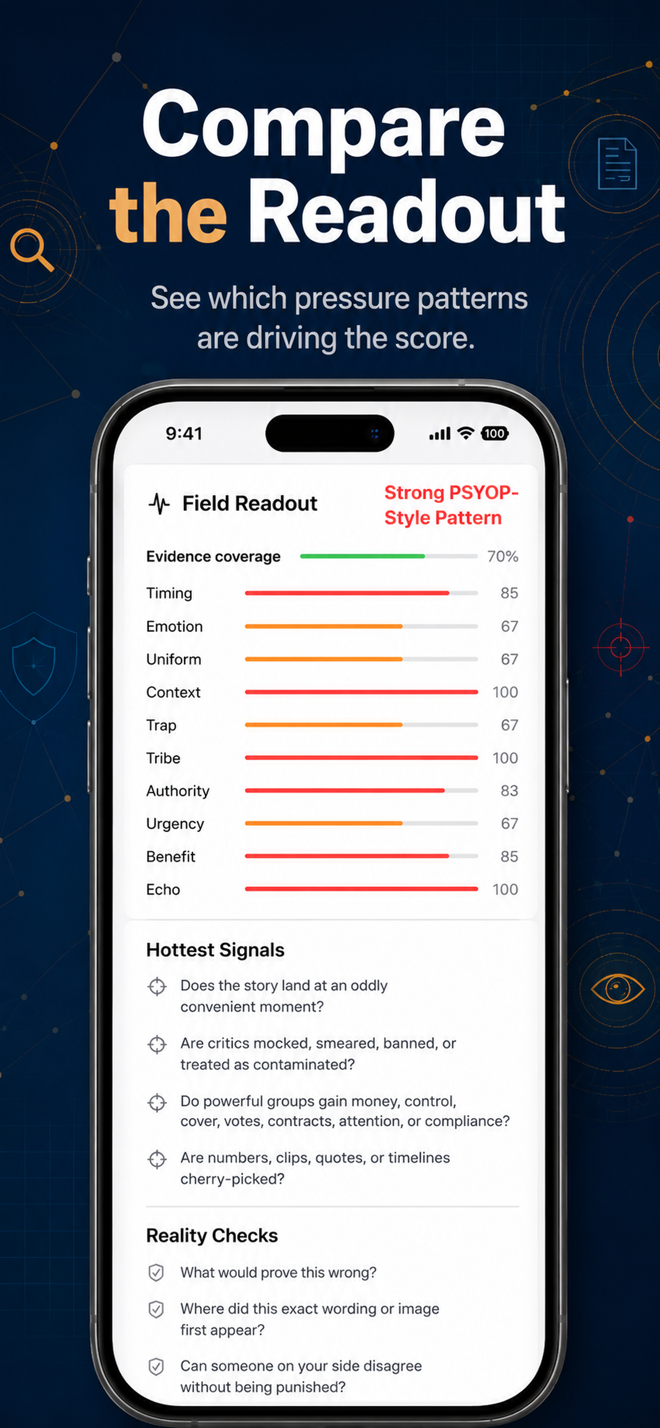
Your answers become a clear pattern readout, with individual signals and the strongest patterns highlighted. See what deserves a closer look.

Challenge your first impression

Reality-check prompts help you question your assumptions and consider what evidence could support or undermine a claim. Keep uncertainty visible.

Keep and share your reasoning

Save your checks and export a report, so a conversation can move beyond ‘I just don’t believe it’ to the reasons behind your view. Your checks stay on your device unless you choose to share.

The value isn’t a secret checklist. It’s the guided workflow, readable results and saved reasoning, ready whenever a story or offer makes you pause. The app does not find evidence for you or automatically prove or disprove a claim.

Start your own check — get the app

Pay once · Full app · No subscriptions · No in-app purchases · No account · Works offline

20 influence signals worth questioning.

A preview of what you’ll explore in the app: 10 Story and 10 Ad / Product categories. Open a category to see what it covers. In the app, guided questions turn your own answers into a signal readout you can save and share—not a verdict on whether something is a lie.

A thinking tool—not a truth detector. A signal is a reason to investigate, not proof of deception or coordination. The absence of signals does not prove a claim true.

Story checks

1. Timing

A story’s timing can shape how it is received. Coincidence is also possible.

2. Emotional Force

Strong feelings can make checking harder. They do not make a claim false.

3. Message Uniformity

Repeated wording may come from a shared source, not independent confirmation.

4. Missing Context

Omitted details can change the meaning of accurate facts.

5. Narrative Trap

A simple either/or story can hide reasonable alternatives.

6. Tribal Pressure

Belonging can become a substitute for examining evidence.

7. Authority Stacking

Credentials should lead to relevant evidence, not end the discussion.

8. Urgency Push

Pressure to act may crowd out verification; some deadlines are genuine.

9. Incentive Trail

Interests are worth examining, but benefiting does not prove orchestration.

10. History Echo

Past patterns can suggest questions, not establish present guilt.

Ad / Product checks

11. Urgency / Scarcity

Limited-time or low-stock claims can accelerate a purchase.

12. Emotional Trigger

A pitch may use insecurity or status instead of product performance.

13. Transformation Promise

Dramatic outcomes need evidence about typical results.

14. Evidence Quality

Specific claims should have checkable support.

15. Social Proof

Popularity and testimonials do not establish reliability.

16. Authority / Influencer

Endorsements can involve payments or unrelated expertise.

17. Price Anchoring

A reference price can make an offer feel better than it is.

18. Missing Downside

Useful offers make limitations and exit terms easy to find.

19. Product Legitimacy

Seller and product details deserve verification; generic imagery alone proves little.

20. Checkout Bypass

A frictionless purchase can leave important terms unread.

You do the thinking. The app does the structure.

Is It a PSYOP? is an educational media-literacy tool. It never tells you something is true, false, a scam, or a real psychological operation. It walks you through structured questions, then turns your own answers into a 0–100 pattern score. This is not a probability that a claim is false or that an operation exists.

Story Check

Viral claims, rumours, announcements, and social posts.

Ad / Product Check

Sales pages, marketplace listings, and hype offers.

20 influence signals

Timing, Urgency, Tribe, Authority, Benefit, Echo, and more.

Export your reasoning

Save checks and share a report of exactly why you are skeptical.

Not a verdict machine. Every score is an educational pattern read based on your own manual answers, not proof of truth, intent, or a real psyop.

A closer look.

Explore the app’s home screen, signal readout and educational case files. These are the same previews used on the App Store. Select any image to enlarge.

Practical app guide

Check an advert before you buy or share

Use Is It a PSYOP? to organise your own reasoning, not to outsource a verdict. Separate the wording of a claim from the evidence that would support it.

Fictional advert: “Only ten left. Everyone is switching to the PocketGlow lamp. Order before midnight.” This example contains urgency and popularity language. Neither phrase establishes the stock level, product quality or whether the offer is misleading.

  1. Capture the exact claim

    Choose Ad/Product Check and paste the wording you want to examine. Keep the original context and date in your notes. Do not replace a specific claim with a more dramatic paraphrase.

  2. Rate signals with evidence

    Work through the influence signals and choose No, Some or Strong based on what you can point to. For this example, note “before midnight” beside urgency. Treat “everyone is switching” as a claim to investigate, not evidence of popularity.

  3. List what remains unknown

    Look for the original offer terms and independent product information. Record what you actually found, where it came from and what would change your mind. An unsupported impression is not verified evidence; do not fill gaps with assumptions.

  4. Read the result in context

    Review the pattern readout alongside evidence coverage and reality-check questions. Save the check or export your reasoning if useful. If sharing, include the original wording and uncertainty rather than posting the number as a verdict.

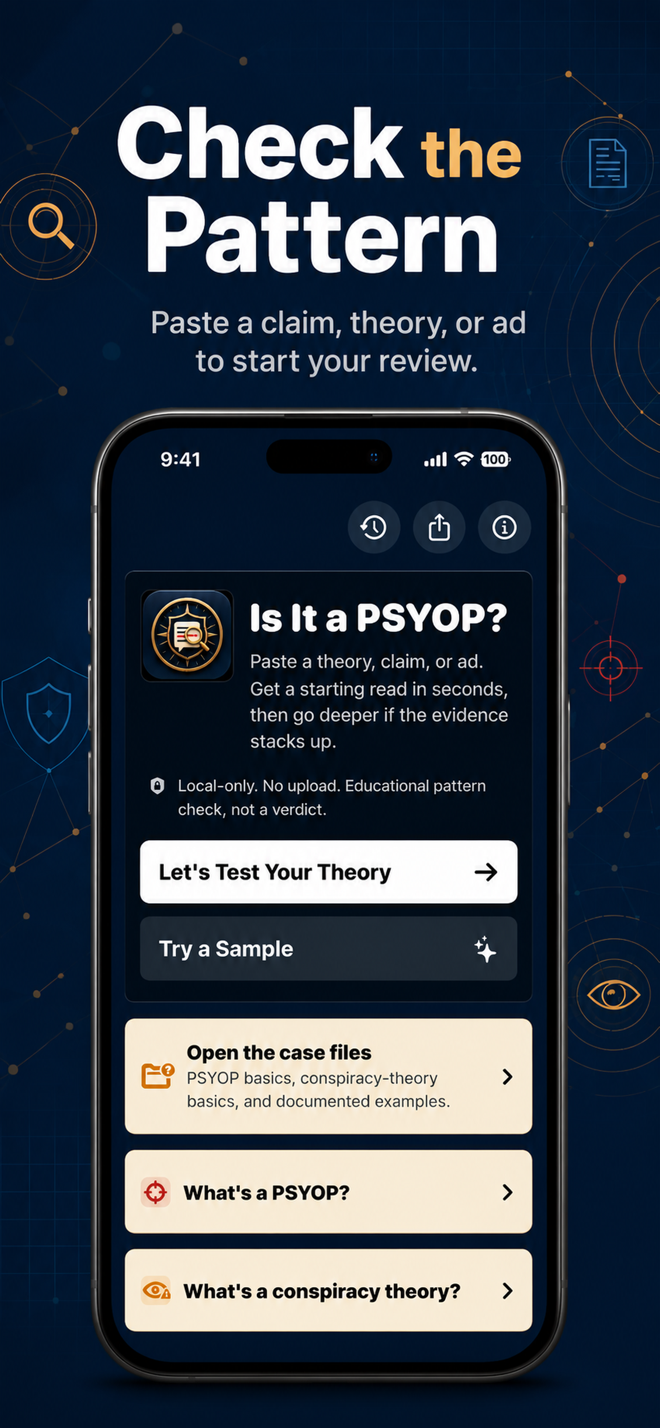
Start with the claim you want to examine — published App Store promotional screenshot
Start with the claim you want to examine. Published promotional artwork; a separate screen sample, not the fictional example above.
Read signals alongside evidence coverage — published App Store promotional screenshot
Read signals alongside evidence coverage. Published promotional artwork; a separate screen sample, not the fictional example above.

Know the limits

The score is an educational pattern read based on your answers. It does not establish truth, fraud, intent or a real psychological operation. The app does not perform AI verification; you do the evidence checking.

View the app on the App Store · Explore the other practical guides

Pause. Question. Reflect.

1. Choose a check

Start with a story, claim, advertisement or product offer you want to think through.

2. Answer the questions

Work through the influence signals using your own observations and evidence.

3. Review your reasoning

Reflect on the pattern score, save your check or export your reasoning. The score is not a verdict on truth.

Get the app

For iPhone · iOS 17 or later · A$5.99 one-off in Australia · Full app · No subscriptions · No in-app purchases. Prices and availability vary by storefront; check your local App Store.

Privacy Policy

Effective date: July 16, 2026. Applies to the iOS app "Is It a PSYOP?"

This app collects no data. There is nothing to disclose, because there is nothing collected.

  • Everything you type, rate, or save stays on your device. Nothing is uploaded, transmitted, or synced to any server.
  • There are no accounts, no logins, no analytics, no advertising identifiers, no crash reporting, and no third-party SDKs.
  • The app makes no network requests. It functions fully offline.
  • Reports you choose to export or share leave your device only by your own action, through the iOS share sheet, to the destination you pick.
  • Deleting the app deletes all of its data.

Because no data is collected, no data is sold, shared, or processed by us or anyone else. If this policy ever changes, the change will be published on this page and reflected in the App Store privacy label before taking effect.

Questions about privacy: support@businessinnovationsaustralia.io

Support

Found a bug, have a feature idea, or need help using the app? Email support@businessinnovationsaustralia.io and include your iOS version and a short description. We aim to reply within 2 business days.

Why won't the app tell me if something is true?
By design. The app structures your own evidence check; it does not replace it. Scores reflect influence patterns you identified, not verified facts.

Where is my data stored?
Only on your device. There is no account to recover and no server copy. Back up via your normal device backup.

Is there a subscription?
No. One payment for the full app. No subscriptions. No in-app purchases.

Is It a PSYOP? is published by Business Innovations Australia.

Business Innovations Australia